Basketball Card Sizes & Dimensions: The Complete Reference (Standard, Thick Cards, Toploaders & Slabs)
Exact basketball card dimensions and the sizing that matters for storage: the standard 2.5 x 3.5 inch card, what card 'points' (pt) really measure, which toploader and one-touch size fits what, whether cards fit a 9-pocket binder, and the vintage 'tall boy' format every collector should know.


Ask a new collector the size of a basketball card and you’ll usually get a shrug. Ask a 20-year collector and they’ll rattle off “two and a half by three and a half” before you finish the sentence — and then, if you let them, they’ll tell you why the thickness is the part that actually determines what you buy to protect it.
That’s the real lesson here. The footprint of a card barely ever changes. What changes — and what quietly ruins cards when collectors get it wrong — is thickness: the gap between a paper-thin base card and a chunky patch card is the difference between a holder that protects and a holder that creases a corner the moment you force the card in. This is the complete reference: exact dimensions, what card “points” really measure, which supply size fits what, and the one vintage-basketball quirk that catches people every year.
The standard basketball card: 2.5 × 3.5 inches
Every current basketball card is 2.5 inches wide by 3.5 inches tall — 63.5 mm by 88.9 mm in metric. This has been the trading-card standard since the late 1950s, and it’s universal across today’s products: Panini’s flagship Prizm, Donruss, Optic, Mosaic, and Select; Topps Chrome and Bowman; Hoops — all of them print base cards, rookies, inserts, and parallels at that exact size.
That consistency is a gift. Because the footprint is fixed, a penny sleeve (sized about 2⅝ × 3⅝ inches, with just enough room to slide a card in), a toploader, a one-touch magnetic holder, and a 9-pocket binder page are all engineered around the same 2.5 × 3.5 rectangle. Once you know a card is standard — and virtually all of yours are — matching supplies becomes trivial. The only variable left to solve is thickness.
Thickness is measured in “points” (pt) — and it’s the number that matters
Here’s the concept that separates people who protect cards well from people who guess: a card’s thickness is measured in points, abbreviated pt, where one point equals one-thousandth of an inch (0.001″). Points have nothing to do with length or width — the card is still 2.5 × 3.5. Points describe how thick the cardboard (or chrome, or relic-loaded) stock is.
A standard base card is thin — comfortably under 35pt — which is exactly why the 35-point holder is the hobby’s default size. From there, thickness climbs as cards get fancier: premium chrome and thick-stock cards run heavier, and jersey, patch, and booklet cards can be several times thicker than a base card because there’s material embedded in them.
Holders are named by the maximum point thickness they’ll hold. A “35pt toploader” fits any card up to 35 points thick. This is the single most useful thing to internalize, because it turns supply-buying from guesswork into matching a number.
The holder point ladder: which size fits what
Use this as your quick-reference for matching a card to a toploader or one-touch magnetic holder. The point size is the maximum thickness the holder accepts — always round up if a card feels snug.
| Holder size | Fits | Typical basketball cards |
|---|---|---|
| 35pt | Standard base cards | Prizm/Chrome/Donruss base, rookies, most inserts and parallels |
| 55pt | Slightly thick stock | Thicker premium base, some chrome inserts |
| 75pt | Thick-stock cards | Heavier premium and thick-stock inserts |
| 100pt | Single-relic cards | Most single jersey/memorabilia cards |
| 130pt | Thicker relics | Heavier jersey cards |
| 180pt+ | Patch & multi-relic | Thick patch cards, dual/triple relics, some booklets |
The rule that saves cards: if a card doesn’t slide in with light, even pressure, don’t force it — go up a point size. Forcing a too-thick card into a 35pt holder is one of the most common self-inflicted corner creases in the hobby. When in doubt, size up; a card rattling slightly in a larger holder is a cosmetic annoyance, while a forced fit is permanent damage.
Sleeves, semi-rigids, and slabs — the other sizes to know
Toploaders and one-touches aren’t the whole storage story. A few more sizes round out what every collector handles:
- Penny sleeves — the thin soft sleeve that goes on first, before any hard holder. Sized to the standard card with a hair of clearance (~2⅝ × 3⅝″). A card should always be sleeved before it touches a toploader; the sleeve takes the friction, not the card.
- Semi-rigid holders (the “Card Saver” style) — flexible-but-firm holders sized for a standard card. These are the grading-submission standard: graders want cards in semi-rigids, not sealed hard toploaders they’d have to cut open. If you plan to submit, keep a stack on hand. (More on that in our grading guide.)
- Graded slabs — once a card is graded, it lives in a sealed plastic slab that’s dramatically larger and thicker than a raw card — far too big for penny sleeves, toploaders, or 9-pocket pages. Slabs need their own graded-card sleeves and slab storage boxes. Never try to force a slab into standard supplies; buy storage made for slabs.
Binders and 9-pocket pages
The classic way to build and show a set is a 9-pocket binder page: a 3-by-3 grid that holds nine standard cards per side — eighteen per sheet when you fill both faces. Standard 2.5 × 3.5 cards are made for these pages, so set-building in a binder is as simple as sliding cards into pockets in checklist order.
Two things to get right. First, buy pages sized for standard trading cards — some pocket pages are cut for other collectibles and will leave your cards loose. Second, binders are for raw cards only — a graded slab will never fit a pocket page. If you want your set protected and browsable in one place, a purpose-built card binder like the RONMONG basketball card binder — hundreds of side-loading pockets built to the standard card size — is the low-effort way to keep a growing collection organized without a toploader for every single common.
The vintage exception: Topps “tall boys”
Here’s the detail that catches new vintage collectors every year, and it’s pure basketball. The 1969-70 and 1970-71 Topps basketball sets are the famous “tall boys” — printed at roughly 2.5 × 4.6875 inches, noticeably taller than a standard card. They were made that way on purpose, and they look striking in person, but they will not fit standard sleeves, toploaders, or 9-pocket pages. Chasing early-’70s Topps hoops means buying tall-boy-specific supplies — sleeves, holders, and pages cut for the taller format.
Topps returned to the standard 2.5 × 3.5 inch size for 1971-72 and every set after, so the tall-boy problem is confined to those two iconic years. If you’re building a vintage run, always measure before you order supplies — it’s a cheap mistake to buy a case of standard toploaders that your tall boys don’t fit.
Why dimensions feed straight into grading
Card size isn’t just a storage question — it’s the foundation of the single most important grading attribute: centering. Grading companies measure how evenly the image sits inside those 2.5 × 3.5 borders, front and back, and centering is the most common reason a would-be Gem Mint 10 comes back a 9. Because the card size is a fixed, known quantity, you can measure your own centering before you ever pay a grading fee. Our card centering calculator does exactly that — enter the border measurements and it tells you the centering percentage graders will see. Pair it with the grading ROI calculator and you’ll know whether a fresh pull belongs in a slab or a sleeve before you spend a dollar.
The bottom line
Basketball cards are 2.5 × 3.5 inches — that part almost never changes. What changes is thickness, measured in points, and matching a card’s point size to the right holder is the whole game in protection: 35pt for standard base cards, climbing to 100pt-plus for relics and patches, and never forcing a snug fit. Raw cards live in penny sleeves and toploaders (or a 9-pocket binder); graded slabs need slab-specific storage; and vintage early-’70s Topps tall boys play by their own oversized rules.
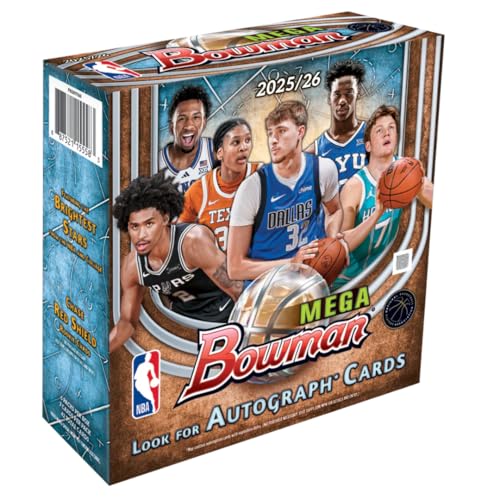
Get the sizing right and protection becomes automatic. If you’re pulling fresh cards worth protecting — the rookie Refractors and chrome parallels in a 2025-26 Topps Chrome mega box, or the prospect autos in a 2025-26 Bowman mega box — sleeve them the moment they hit the table, run them through the centering calculator, and store them in supplies sized to the card. New to the hobby’s box formats? Start with our hobby vs retail explainer.
Recommended Products for This Guide
RONMONG Basketball Card Binder, 440 Pockets, Protective Trading Card Album | Double Sided Sleeves for 2026 Basketball Cards, Sports Card Storage and Display, Great Gift for Collectors, Boys and Fans
In Stock at AmazonEssential supplies to protect and display your card collection.
- Protects your collection
- High quality materials
2025-26 Topps Chrome Basketball - Factory Sealed - Mega Box
In Stock at AmazonTopps·2025-26·Mega box
- Extra packs included
- Exclusive mega content
2025-26 Bowman Basketball - Mega Box - Factory Sealed - Look for Autograph Cards - Made in USA
In Stock at AmazonBowman·2025-26·Mega box
- Extra packs included
- Exclusive mega content